Filters
Question type

Study Flashcards

The solubility of CO2 gas in water


A) increases with increasing gas pressure.
B) increases with decreasing gas pressure.
C) decreases with increasing gas pressure.
D) is not dependent on pressure.

E) A) and C)
F) All of the above

Correct Answer

verifed

verified

What is the percent CsCl by mass in a 0.711 M CsCl solution that has a density of 1.091 g/mL?


A) 3.87 * 10-4 %
B) 3.87 * 10-1 %
C) 11.0 %
D) 1.10 %
E) 6.50 * 10-2 %

F) A) and D)
G) A) and C)

Correct Answer

verifed

verified

What is the osmotic pressure of a solution prepared from 13.7 g of the electrolyte HCl and enough water to make 0.500 L of solution at 18°C?


A) 0.55 atm
B) 1.10 atm
C) 8.95 atm
D) 17.9 atm
E) 35.9 atm

F) B) and C)
G) D) and E)

Correct Answer

verifed

verified

The density of a 20.3 M CH3OH (methanol) solution is 0.858 g/mL. What is the molality of this solution? H2O is the solvent.


A) 17.4 m
B) 20.8 m
C) 23.7 m
D) 70.0 m
E) 97.6 m

F) A) and B)
G) A) and C)

Correct Answer

verifed

verified

What volume of water should be added to 600. mL of ethanol in order to have a solution that boils at 95.0°C? (For ethanol, Kb = 1.22 °C/m, density = 0.789 g/cm3, boiling point = 78.4°C)


A) 186 mL
B) 245 mL
C) 518 mL
D) 116 mL
E) 322 mL

F) A) and B)
G) A) and C)

Correct Answer

verifed

verified

Oxygen gas makes up 21 % of the atmosphere by volume. What is the solubility of O2(g) in water at 25°C if the atmospheric pressure is 741 mmHg? The Henry's law constant for oxygen gas at 25°C is 1.3 * 10-3 mol/L·atm.


A) 2.7 * 10-4 M
B) 1.3 * 10-3 M
C) 6.2 * 10-3 M
D) 9.6 * 10-3 M
E) 0.96 M

F) B) and D)
G) None of the above

Correct Answer

verifed

verified

Which of the following aqueous solutions has the highest osmotic pressure at 25°C?


A) 0.2 M KBr
B) 0.2 M ethanol
C) 0.2 M Na2SO4
D) 0.2 M KCl

E) A) and B)
F) All of the above

Correct Answer

verifed

verified

Which of the following aqueous solutions has the highest boiling point? Kb for water is 0.52°C/m.


A) 0.2 m KCl
B) 0.2 m Na2SO4
C) 0.2 m Ca(NO3) 2
D) A and B.
E) B and C.

F) A) and D)
G) A) and E)

Correct Answer

verifed

verified

Which of the following gives the molarity of a 17.0 % by mass solution of sodium acetate, CH3COONa (molar mass = 82.0 g/mol) in water? The density of the solution is 1.09 g/mL.


A) 2.26 * 10 - 6 M
B) 0.207 M
C) 2.07 M
D) 2.26 M
E) 2.72 M

F) A) and B)
G) B) and D)

Correct Answer

verifed

verified

D

A 100.-mL sample of water is taken from the Pacific Ocean, and the water is allowed to evaporate. The salts that remain (mostly NaCl)have a mass of 3.85 g. Calculate the original concentration of NaCl, in g per liter, in the water sample.

Correct Answer

verifed

verified

38.5 g/L

The term "proof" is defined as twice the percent by volume of pure ethanol in solution. A solution that is 95% ethanol is 190 proof. What is the molarity of ethanol in a 92-proof ethanol/water solution? (Given: density of ethanol = 0.80 g/cm3; density of water = 1.0 g/cm3)

Correct Answer

verifed

verified

What is the freezing point of a solution that contains 10.0 g of glucose (C6H12O6) in 100. g of H2O? Kf for water is 1.86°C/m.


A) -0.186°C
B) +0.186°C
C) -0.10°C
D) +0.10°C
E) -1.03°C

F) A) and C)
G) B) and C)

Correct Answer

verifed

verified

The solubility of CO2 gas in water


A) increases with increasing temperature.
B) decreases with decreasing temperature.
C) decreases with increasing temperature.
D) is not dependent on temperature.

E) All of the above
F) B) and C)

Correct Answer

verifed

verified

What is the molality of a solution that is 3.68 % by mass calcium chloride?


A) 0.0332 m
B) 0.332 m
C) 0.344 m
D) 0.464 m
E) 0.506 m

F) A) and E)
G) B) and E)

Correct Answer

verifed

verified

C

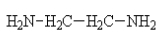
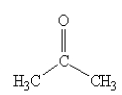
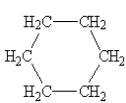
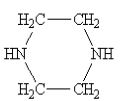
Which one of the following would be immiscible with water?


A) Which one of the following would be immiscible with water? A)    B)    C)    D)    E)
B) Which one of the following would be immiscible with water? A)    B)    C)    D)    E)
C) Which one of the following would be immiscible with water? A)    B)    C)    D)    E)
D) Which one of the following would be immiscible with water? A)    B)    C)    D)    E)
E) Which one of the following would be immiscible with water? A)    B)    C)    D)    E)

F) A) and B)
G) A) and C)

Correct Answer

verifed

verified

Automobile radiators usually carry a sticker that indicates that they must contain an antifreeze solution for proper operation, winter or summer. Why should you not use ordinary water during the summer?

Correct Answer

verifed

verified

The antifreeze will lower the vapor pres...

View Answer

What is the osmotic pressure of a 0.25 M solution of sucrose at 37°C? (R = 0.0821 L.atm/K.mol)


A) 6.6 * 10-5 atm
B) 0.76 atm
C) 6.4 atm
D) 100 atm
E) 940 atm

F) None of the above
G) B) and E)

Correct Answer

verifed

verified

A 9.50 % by mass solution of acetone (C3H6O) in water has a density of 0.9849 g/mL at 20°C. What is the molarity of this solution?


A) 0.621 M
B) 1.61 M
C) 1.66 M
D) 1.71 M
E) 16.9 M

F) C) and D)
G) D) and E)

Correct Answer

verifed

verified

Calculate the molality of a 20.0% by mass ammonium sulfate (NH4) 2SO4 solution. The density of the solution is 1.117 g/mL.


A) 0.150 m
B) 1.51 m
C) 1.70 m
D) 1.89 m
E) 2.10 m

F) B) and C)
G) A) and D)

Correct Answer

verifed

verified

The solubility of oxygen in water is about 4.5 * 10-2 g/L. The water portion of an adult's total blood supply is about 5 liters. How many grams of oxygen could dissolve in 5 liters of water?

Correct Answer

verifed

verified

Showing 1 - 20 of 109

Related Exams

Show Answer